Trade guide

Eight kinds of glass, eight sets of rules.

The most expensive damage in this trade comes from treating every pane as plain annealed glass. Here is how we identify what is in front of us, and what each type forbids.

Close detail of a glass surface
01

Soft-coat low-E

Sputtered low-E, surface 2 or surface 3 coating

Where you find it here: Almost every window installed in New Hanover County since 2010.

Identifying it

Hold a flame or a pen light against the glass and count the reflections. A coated pane shows one reflection in a different colour to the others. On a sealed unit the coating is almost always on an inner surface, but on single-glazed retrofits it can be exposed.

Why it matters

The coating is a microscopically thin metallic stack, usually silver-based. It is soft enough to mark with a scraper and it oxidises fast once the seal fails or the coating is exposed to air.

How we clean it

Pure water or a neutral solution, soft mop, squeegee. Exposed coatings get the gentlest option available and no mechanical work at all.

Never

No steel wool, no razor, no abrasive pad, no acidic restorer. One pass with a blade leaves a permanent haze.

02

Hard-coat low-E

Pyrolytic low-E

Where you find it here: Storm windows, older retrofits, some commercial spandrel.

Identifying it

Fired onto the glass while it is still hot during float production, so the coating is fused into the surface. It is noticeably more durable than a sputtered coat and often carries a very faint haze at an angle.

Why it matters

Durable enough for normal cleaning, but it still holds mineral deposit more readily than uncoated glass because the surface is marginally less smooth.

How we clean it

Standard wash. Deposits respond to a dwell-time dissolver rather than pressure.

Never

No hydrofluoric or ammonium bifluoride restorers. They will etch the coating unevenly and the patch will always show.

03

Tempered (toughened)

Safety glass, heat-treated

Where you find it here: All doors, sidelights, low panes under 18 inches, shower glass, and every solar module.

Identifying it

Look for the etched bug in a corner. Under polarised sunglasses you can often see the roller-wave pattern from the tempering oven as faint stripes.

Why it matters

Tempering leaves microscopic particles of glass fused to the surface, known as fabricating debris. Running a blade over it drags those particles and scratches the pane. The scratch is blamed on the cleaner every time.

How we clean it

Wash and squeegee only. If a deposit needs mechanical removal we test a small area first and document it with the client before proceeding.

Never

Never blade tempered glass as a routine step. Industry guidance has been clear on this since the 1990s and it is the single most common cause of window-cleaning damage claims.

04

Laminated impact glass

Hurricane glass, PVB interlayer

Where you find it here: Oceanfront Wrightsville Beach and Carolina Beach builds, 2003 onward.

Identifying it

Look at the edge of the pane. A laminate shows a thin dark line between two glass layers. Coastal builds after the 2003 code changes almost all use it on the ocean side.

Why it matters

The glass face cleans normally, but the exposed edge is a plastic interlayer. Solvents and standing water at the edge cause delamination, which shows as a creeping cloudy margin.

How we clean it

Normal wash. Keep solutions off the edge, dry the perimeter properly, and report any existing edge cloudiness in writing.

Never

No solvent-based cleaners near the glazing edge, and never leave water standing in the rebate.

05

Applied window film

Aftermarket tint, security film

Where you find it here: Wilmington midtown retrofits, west-facing rooms, most office suites downtown.

Identifying it

Run a fingernail along the edge of the pane from inside. Applied film has a discernible edge and often a small gap to the frame. Factory tint runs edge to edge with no lip.

Why it matters

Film is a polyester layer with an adhesive behind it. It scratches far more easily than glass, ammonia attacks the adhesive, and lifting corners get worse with every wash if nobody notices them.

How we clean it

Interior side only: neutral solution, soft mop, light squeegee pressure, dry edges last.

Never

No ammonia, no abrasives, no blade, and no aggressive squeegee pressure across a lifting edge.

06

Leaded and came glass

Stained glass, diamond quarrel lights

Where you find it here: Historic Southport, downtown Wilmington front doors and transoms.

Identifying it

Individual small panes held in lead or zinc came, usually in a transom, a front door sidelight or a historic church window.

Why it matters

The came is soft metal and the cement between came and glass is often a century old. Pressure on the panel flexes the whole assembly, which cracks the cement and starts a rattle that becomes a leak.

How we clean it

Dry dusting first, then a barely damp soft cloth, pane by pane, with a hand supporting the back of the panel. Frequency low, pressure lower.

Never

No hose, no pole, no pressure washer, no standing water. Water sitting on came accelerates corrosion.

07

Historic annealed glass

Cylinder glass, wavy glass, original float

Where you find it here: Historic District Wilmington, Southport waterfront cottages.

Identifying it

Look through it at a straight line outside. Nineteenth-century cylinder glass distorts the line visibly. Seed bubbles and thickness variation are normal, not damage.

Why it matters

The pane is thin, sometimes under 2 mm, and usually held by brittle lime putty. It breaks under pressure that modern glass shrugs off, and replacement glass will never match.

How we clean it

Light contact, soft mop, no pressure near the glazing line, and hand-drying the putty edge so water does not sit against it.

Never

No blade near the putty, no pole work, and no attempt to 'clean out' the surface distortion. That distortion is the glass.

08

Self-cleaning titanium dioxide

Photocatalytic coated glass

Where you find it here: A small number of newer architect-designed builds around Landfall and Figure Eight.

Identifying it

Usually a builder or architect spec item, listed on the glazing schedule. Water sheets across it rather than beading.

Why it matters

The coating uses UV to break down organic soil and a hydrophilic surface to sheet it away. Ordinary detergent films sit on top of the coating and stop it working.

How we clean it

Plain water only, or the manufacturer's specified cleaner. Rinse thoroughly and leave it to sheet dry.

Never

No detergents, no silicone-based polishes, no abrasives. Any of the three disables the coating until it weathers off.

Blade policy

When a scraper comes out, and when it does not

A stainless blade is the fastest way to remove bonded debris from glass, and the fastest way to ruin a pane that cannot take it. Our rule is written down and every technician follows it.

  1. Annealed glass only

    Historic and standard annealed panes, and only where a deposit genuinely needs mechanical removal.

  2. Always a test area first

    A short pass at the edge of the pane, inspected at a low angle before anything else happens.

  3. Wet, flat, one direction

    Never dry, never on edge, never back and forth. A dry blade on any glass is a scratch waiting to happen.

  4. Never on tempered, low-E or film

    Tempered glass carries fabricating debris. Soft-coat low-E is a metallic stack. Film is polyester. All three lose.

A window cleaner working exterior glass by hand

Two methods, one job

Pure water outside. Squeegee inside.

A crew that only owns one method will use it everywhere, including where it is the wrong answer. Almost every visit we run uses both: a water-fed pole for exterior elevations and reach, a mop and channel squeegee wherever the glass needs contact and control.

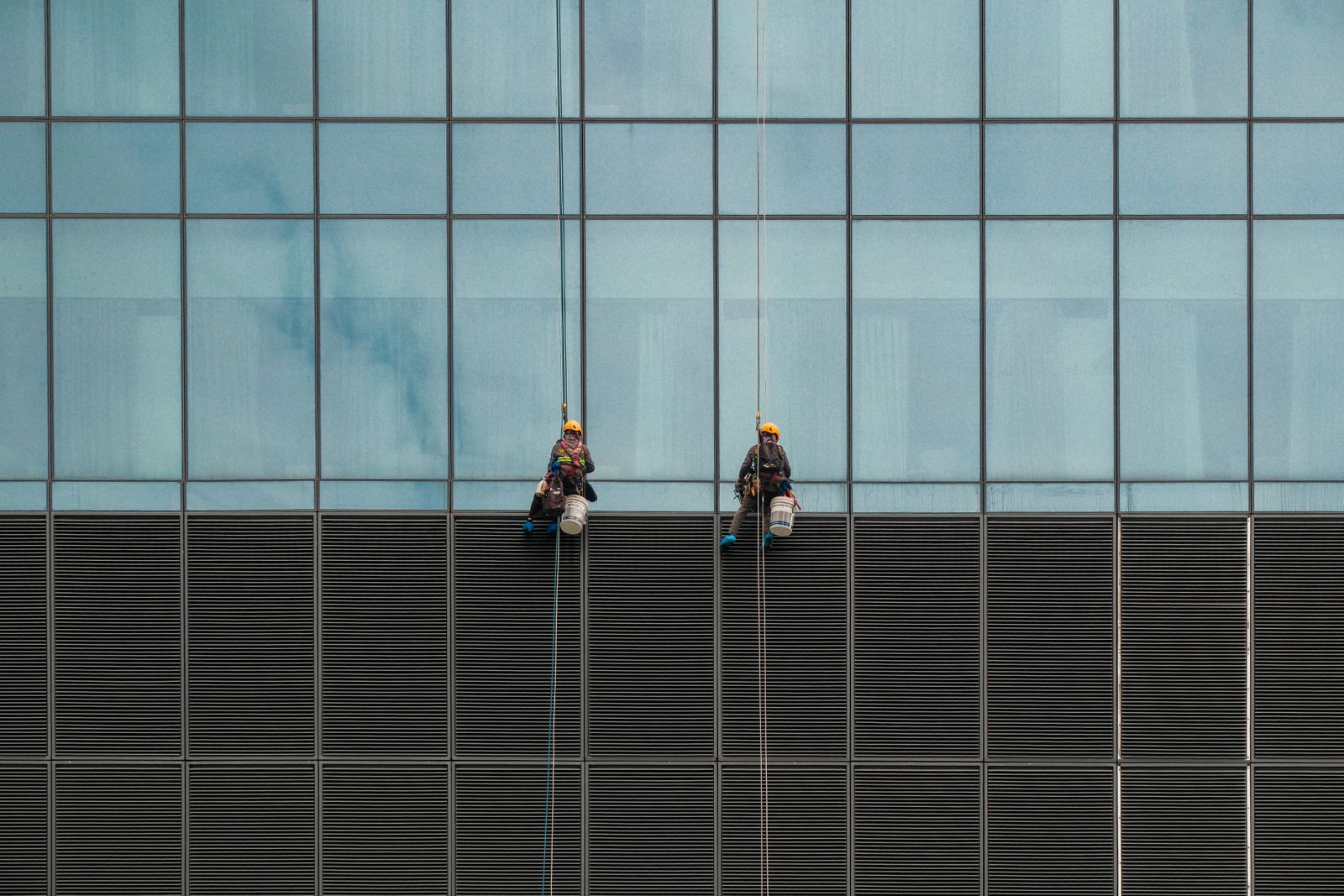
Exterior glass being washed on a building facade

Water-fed pole, pure water

Deionised water on a carbon-fibre pole. No detergent, no ladder, no towel.

Mains water is passed through a sediment filter, a carbon block and either a reverse osmosis membrane or a deionising resin bed until total dissolved solids read under 10 ppm. Pure water is aggressively hungry for minerals, so it lifts salt, pollen and soil off the glass on contact, then evaporates leaving nothing behind. That is why there is no towel and no squeegee: there is nothing in the water to dry into a spot.

Used for

  • Exterior glass from ground level up to about four storeys
  • Salt film on oceanfront and sound-front elevations
  • Frames, sills and the underside of transoms in a single pass
  • Properties where ladders would sit on flower beds, decks or HVAC units
  • Solar arrays, where detergent residue is actively harmful

Where it stops

  • Needs the water to read under 10 ppm TDS. Above that it spots, and the operator must check
  • Loses control in sustained wind over about 20 mph at full extension
  • Cannot remove bonded deposit such as mortar splash, paint or stage 2 mineral etch
  • Not used on interiors: too much water for a finished room
Reach
Practical working reach on this coast is four storeys. Poles are built longer, but coastal wind makes flex unmanageable beyond that.
Water or solution
Under 10 ppm total dissolved solids, measured with an in-line meter before the first pane.
Kit list
  • Carbon-fibre pole, 20 to 45 ft working sections
  • Dual-trim brush with rinse bar jets
  • RO membrane plus DI resin polishing vessel
  • In-line TDS meter, checked at the start of every job
  • Van tank, typically 350 to 650 US gallons

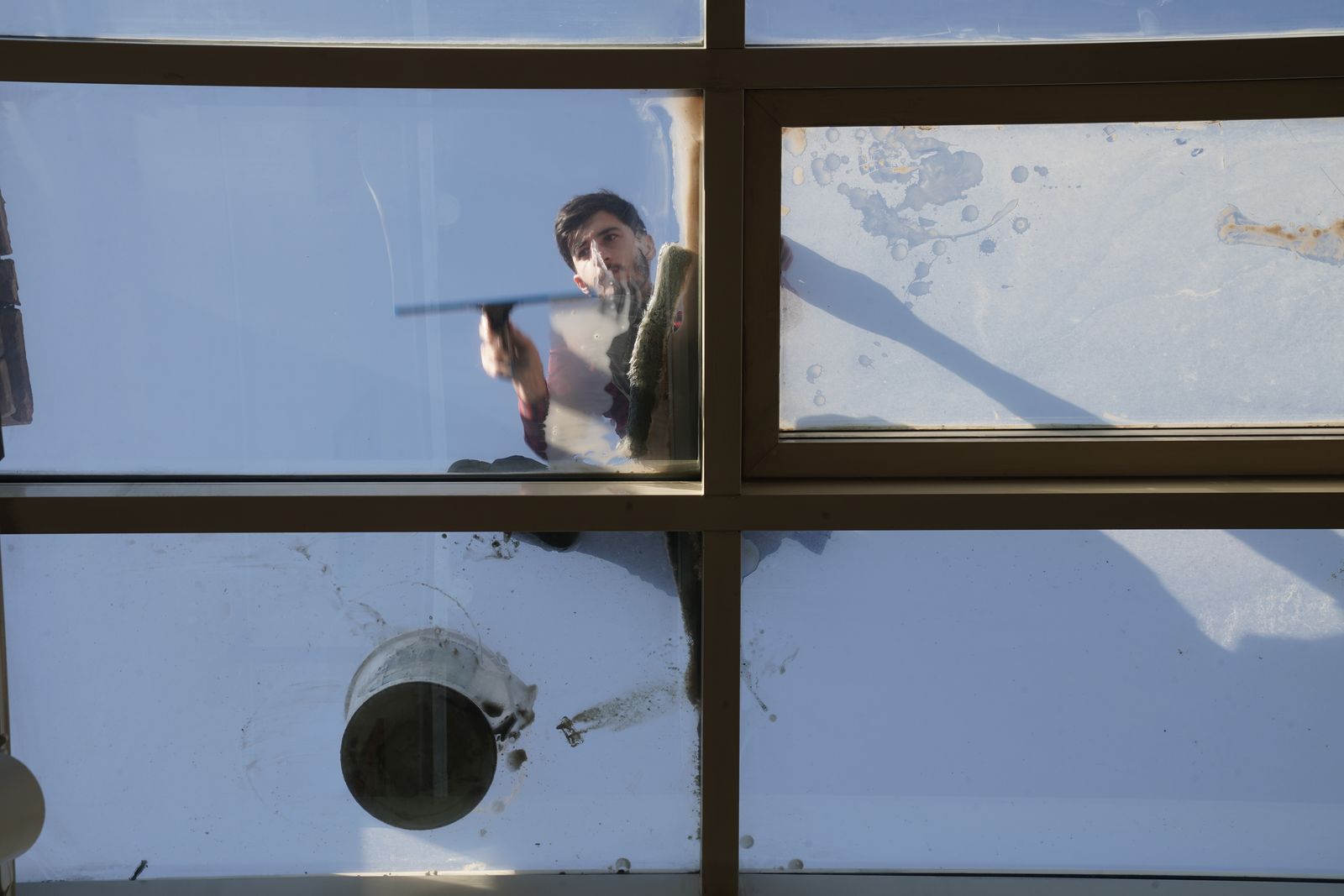
A window cleaner working exterior glass with a hand tool

Mop and squeegee, traditional

Applicator, channel squeegee and scrim. Contact work where contact is what is needed.

A washer sleeve carries a dilute neutral solution onto the glass and agitates the soil, then a brass or stainless channel squeegee with a fresh rubber pulls the water off in a controlled pattern. The perimeter is finished with a scrim or a lint-free cloth. This is the method that has cleaned glass for a century, and it is still the only one that applies real mechanical force with full control.

Used for

  • Every interior pane, without exception
  • Ground-floor exteriors where the glass needs agitation, not just rinsing
  • Storefront and commercial entry glass with traffic film and handprints
  • Post-construction glass with labels, stickers and light overspray
  • Historic and leaded glass, where pressure and water volume must be tiny

Where it stops

  • Needs a ladder or lift above ground floor, which brings its own risk and its own cost
  • Leaves a detergent film if the solution is over-dosed or under-rinsed
  • Slower per pane than a pole on a large open elevation
  • Blade work is unsafe on tempered glass and forbidden on soft-coat low-E
Reach
Ground floor by hand. Second storey by ladder with a standoff. Above that, the job belongs to a pole, a lift or a rope.
Water or solution
Dilute neutral surfactant, roughly one ounce per two gallons. Stronger is not better, it just leaves film.
Kit list
  • Brass channel, 6 to 18 inch, with fresh-cut rubber
  • Microfibre or synthetic washer sleeve
  • Scrim or lint-free finishing cloth
  • Stainless scraper, used only on annealed glass and only when needed
  • Drop cloths, sill towels and shoe covers for interior work

How a residential visit runs, step by step

Not sure what you have

Send a photo and we will tell you.

A shot of the corner of the pane, plus one taken at a low angle in daylight, is usually enough for us to name the glass and the right method.

Insured and IWCA. Certificates issued to your property manager on request.

Cookie preferences

Choose which cookies you allow. You can change this at any time from the link in the footer.